
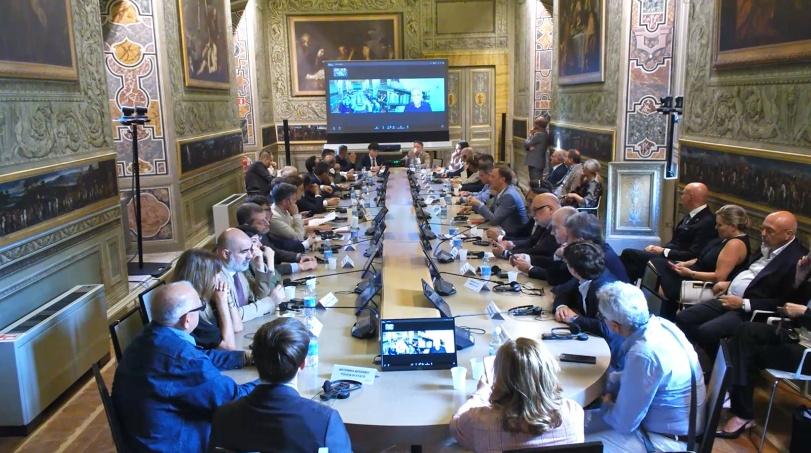
ISGAP’s Vice President of Policy, Haras Rafiq, visited Rome for three days of high-level meetings and policy discussions organized by ISGAP’s Director in Italy, Dr. Robert Hasan. The visit brought together senior political figures, parliamentary officials, security and financial experts, journalists, and institutional stakeholders to address pressing challenges including antisemitism, Islamist radicalisation, extremist financing, foreign influence, and democratic resilience.
During the visit, Haras Rafiq delivered a keynote presentation at the roundtable “The Financial Influence of Radical Groups in Western Contexts” at the American Studies Center in Rome, introduced by ISGAP Founder and President Dr. Charles Asher Small. In the keynote, Haras Rafiq argued that antisemitism should be understood not in isolation, but as part of a wider ecosystem of Islamist radicalisation, extremist financing, and foreign influence that undermines liberal democratic institutions. He examined how contemporary extremist movements increasingly operate through interconnected financial, organisational, and ideological ecosystems rather than violence alone, exploiting democratic freedoms, charitable and educational institutions, and transnational financial channels to build influence, shape narratives, and create permissive environments for radicalisation.
He also participated in the 2nd Rome Roundtable 2026 on European Order and Middle East Security Architecture, highlighting the growing intersection between regional instability, extremist networks, and domestic security challenges facing Europe. The discussions strengthened ISGAP’s engagement with European policymakers and opened opportunities for future collaboration in research, strategic briefings, institutional training, and policy development.


ISGAP’s Rome engagement also generated press coverage in HaKol/Il Riformista under the title “Tavola rotonda ISGAP: sicurezza, finanziamenti e rischio radicalizzazione nelle democrazie liberali [ISGAP Roundtable: Security, Financing and Radicalization Risk in Liberal Democracies].”
The article positioned the roundtable as a timely contribution to Italy’s public debate on security, radicalisation, extremist financing and the resilience of liberal democracies. It highlighted the importance of following the money behind radical networks and understanding how financial influence can support ideological mobilisation, propaganda, recruitment, institutional influence and the gradual weakening of democratic norms. The coverage helped move ISGAP’s analysis from private briefings and parliamentary meetings into the Italian media space, reinforcing ISGAP’s strategic value as a leading voice on extremist financing, radical networks, foreign influence and the protection of liberal democratic institutions. The article also strengthens the case for future public briefings, institutional training, policy research and media-facing engagement in Italy and across Europe.