
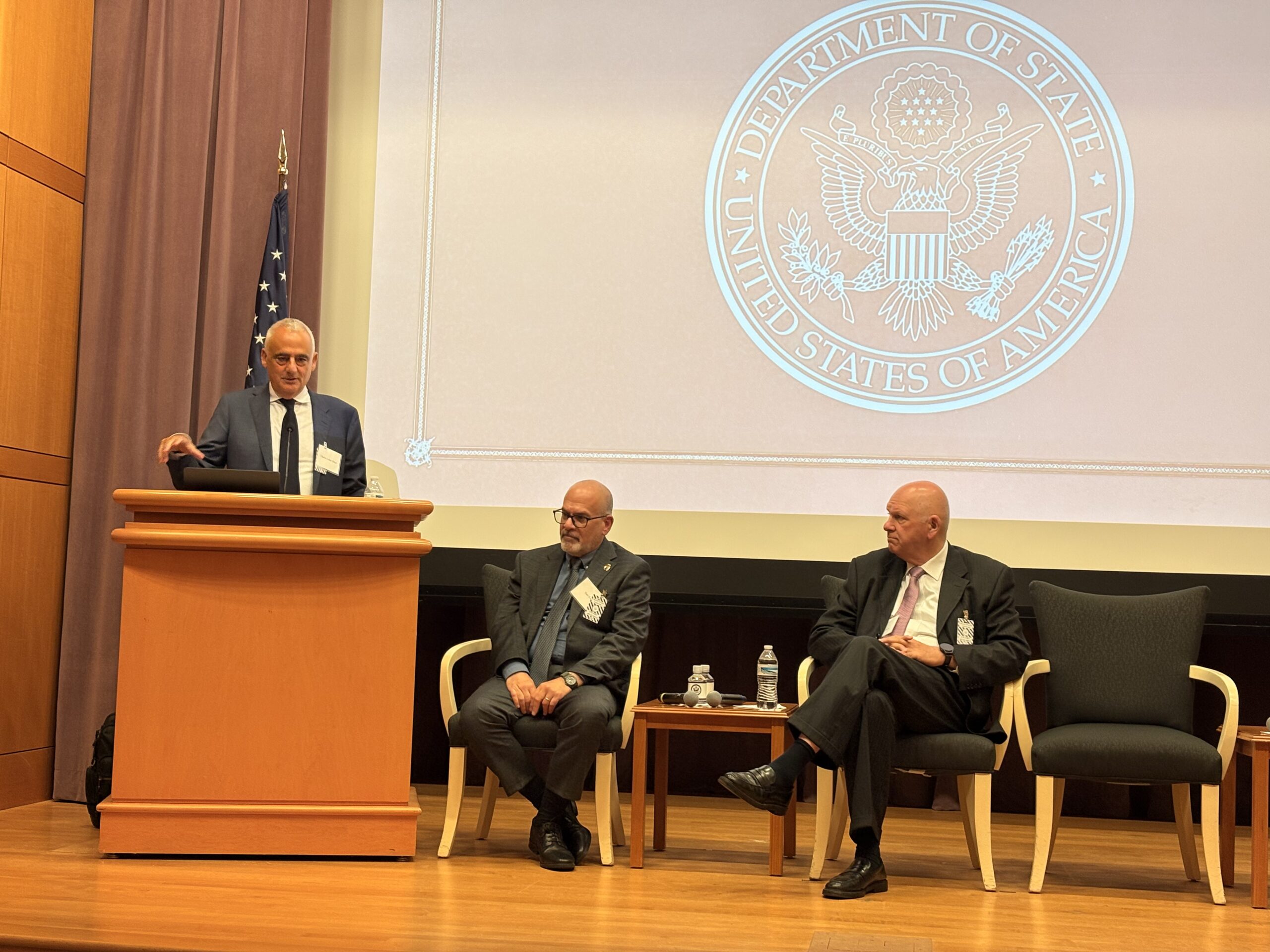
Speaking at a U.S. State Department symposium on antisemitism, the ISGAP Executive Director highlighted the role of foreign influence networks, extremist ideologies, and institutional actors in shaping contemporary antisemitism
WASHINGTON, D.C. — June 14, 2026 — Dr. Charles Asher Small, Executive Director of the Institute for the Study of Global Antisemitism and Policy (ISGAP), delivered a keynote address at a symposium hosted last week, on June 11, by the U.S. Department of State’s Office of the Special Envoy to Monitor and Combat Antisemitism. He warned that foreign influence networks are playing an increasingly significant role in fuelling the rise of antisemitism across the United States.
The symposium marked a laudable milestone in the U.S. government’s response to antisemitism, bringing together representatives from the security, intelligence, law enforcement, policy, academic, and civil society communities to examine antisemitism as an emerging strategic challenge facing democratic societies.
Drawing on ISGAP’s research into foreign influence, Qatar-linked educational initiatives, and extremist ideological networks, Dr. Small examined how external actors can shape educational institutions, public discourse, and attitudes toward Jews and Israel.
In his remarks, Dr. Small said: “Antisemitism is not a simple or parochial issue of hatred against a small community. It is a core element of the ideology of extremists intent on destroying democratic countries, including the United States. Antisemitism must be understood as a major security threat to the stability and cohesion, indeed the very fabric, of our great democratic nation and its core institutions. This is especially true in higher education, where young people learn to be citizens. This ideology, which aims to destroy the very notion of a liberal education, also believes in the subjugation of women and the murder of gay people and Jews.”
The symposium featured remarks from top government officials, including Dr. Sebastian Gorka, Senior Counselor to the President, and Rabbi Yehuda Kaploun, U.S. Special Envoy to Monitor and Combat Anti-Semitism.
“I thank Ambassador Kaploun and the State Department for convening this first-ever symposium, which brought together law enforcement and intelligence community professionals and others to hear from those of us in civil society who have for years been doing research and advocacy on the national security issues our country is facing from transnational Islamism and antisemitism. ISGAP is proud to be a key player at this historic event,” Dr. Small added.
Dr. Small’s presentation drew on ISGAP’s extensive body of research into foreign influence and ideological networks operating within American educational and civic institutions. Through its Follow the Money Project, ISGAP uncovered billions of dollars in previously undisclosed foreign gifts and contracts to American universities, helping expose the scale of foreign involvement in higher education across the United States.
Most recently, ISGAP published its landmark report, Institutional Capture: Qatar Foundation International: Use of Soft Power to Reshape Education in the United States, which documented more than $65 million in funding directed through over 220 educational programs reaching K-12 schools, universities, teacher-training initiatives, federally funded educational centers, and national educator networks. The report forms part of ISGAP’s broader research into Qatar’s role within American education and its wider examination of foreign funding, transparency, and state-linked influence operations.
ISGAP has also conducted extensive research into the Muslim Brotherhood and affiliated ideological networks, examining how such movements gain influence within educational, civic, and political institutions and the role they can play in promoting antisemitic, extremist, and anti-democratic narratives. Dr. Small argued that these findings demonstrate how foreign influence networks and ideological movements can help create the conditions in which antisemitism spreads and gains legitimacy.
***
June 12, 2026
Dr. Charles Asher Small Also Comments on Article Published by the American Association of Universities rejecting the DETERRENT ACT
“Given the sacred responsibility of universities to educate the citizens of the future and knowing what we now know today about the potential for foreign influence through foreign funding, it is very disappointing that the American Association of Universities just announced that it rejects the DETERRENT ACT legislation that sets forth the updated transparency requirements for universities that solicit and receive foreign funding for their various educational programs and initiatives. When universities receive taxpayer dollars through federal funds, they agree to disclose certain levels of foreign funding so that the public can review the source and nature of the funding going to those universities. Taxpayers are entitled to that information. The bill in no way prohibits any university from receiving foreign funding nor will it impact legitimate foreign language studies, student exchanges, or other cultural programs. Congress should pass this bill as soon as possible.”