
Bipartisan Members of Congress express dismay over findings on foreign influence in American education, as report submitted to Department of Education and Congress details Qatari state influence over schools, universities, and federally funded programs
NEW YORK – May 27, 2026 – The Institute for the Study of Global Antisemitism and Policy (ISGAP) today released a new report documenting the extensive role of Qatar Foundation International across U.S. education systems. The report has already prompted strong bipartisan reactions from members of Congress, with lawmakers expressing alarm over the scale of the alleged foreign influence operations uncovered by ISGAP and calling for increased oversight, transparency, and federal scrutiny.
ISGAP has formally submitted its findings to the U.S. Department of Education and the Department of the Treasury’s Office of Intelligence and Analysis, as well as to the Chairmen and Ranking Members of the Senate and House Judiciary Committees, the Senate Finance Committee, the House Ways & Means Committee, and the House and Senate education committees, including relevant K-12 education subcommittees.
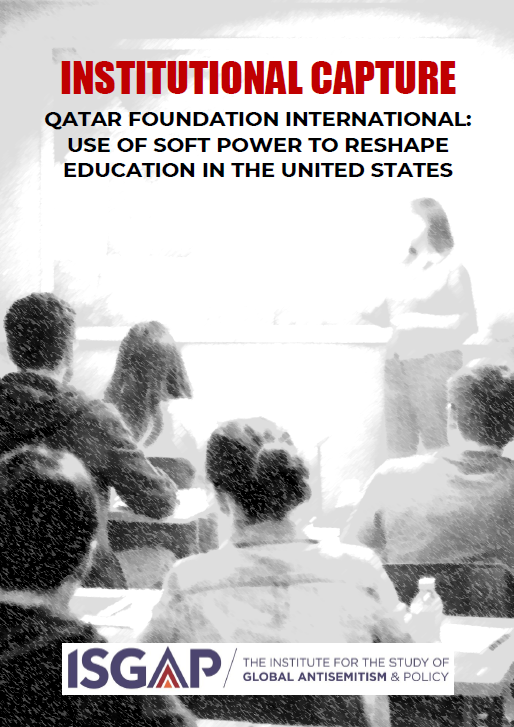
The report, Institutional Capture: Qatar Foundation International: Use of Soft Power to Reshape Education in the United States, details more than $65 million in funding across over 220 programs between 2009 and 2025, reaching K–12 schools, major universities, teacher training initiatives, and national educator networks.
“Given the scale, duration, and structure of these activities, this is not a series of isolated educational programs. The report specifically documents how foreign-linked funding was used to shape educational content and educator training in ways that were not transparent to institutions, regulators, or the public,” said Dr. Charles Asher Small, Executive Director of Institute for the Study of Global Antisemitism and Policy. “The bipartisan reaction from members of Congress underscores the seriousness of these findings and the growing concern surrounding foreign influence within American education. These findings require decisive action. We are calling on federal authorities to conduct a full review of these activities, to examine how they intersect with publicly funded programs, and to ensure that transparency and accountability are upheld across the entire education system.”
According to the report, QFI’s activities have extended well beyond what QFI describes solely as Arabic language education, with QFI embedding itself deeply and broadly into curriculum and programming on history, geography and culture, with particular focus on curriculum development and professional education for teachers. Its operations, as revealed by key documents and communications, were strategically designed to permeate multiple layers of the U.S. education system, including partnerships with universities, the control of educator networks to disseminate QFI’s own content, and the development of educator training pipelines and classroom-linked resources. The report argues that, taken together, these efforts extended far beyond an introduction toArabic language and functioned as a coordinated, multiyear strategy that shaped how the Middle East is presented in American classrooms.
Among the findings, the report documents how QFI partnered with federally funded Title VI Middle East National Resource Centers housed at specific universities including Duke-UNC and the University of Texas at Austin. These centers, supported by U.S. taxpayer funding and mandated to provide balanced educational resources through outreach programs to K-12 educators in their surrounding regions, became key distribution channels for QFI-linked initiatives. QFI specifically leveraged relationships with the university outreach coordinators to disseminate QFI-backed materials and programming to educators nationwide and indeed, to scale QFI’s influence far beyond the purpose for which the federally funded National Resource Center structure was designed.
The report also highlights direct classroom-level impact. In New York City, a public school receiving QFI funding which was found to have used classroom materials in which Israel was omitted from maps and replaced entirely with “Palestine,” prompting a formal Congressional inquiry. In other cases, teachers participating in professional education programs funded by QFI grants were required to produce specified lesson plans and submit them to QFI for review, creating a pipeline through which materials had direct QFI oversight and were developed, refined, and redistributed. QFI representatives were present in public school classrooms for a virtual classroom partnership with the United Nations Relief and Works Agency for Palestine Refugees (UNRWA) schools, with the QFI-funded program culminating in advocacy projects that occupied a third of the instructional year. And QFI further used its grants and its control over the Middle East Outreach Council, a purportedly apolitical and nonpartisan educator network, to steer particular content into school classrooms and libraries.
The report documents QFI’s involvement in teacher training programs and curriculum initiatives reaching thousands of educators, bolstered by QFI’s partnerships with reputable universities. This includes a partnership with Brown University’s recently canceled Choices Program, which had distributed curriculum to over 8,000 schools and a million students nationwide and was the subject of a 2025 report by ISGAP. It also includes multi-year teacher leadership programs in which QFI trained teachers across key cities in the US and culminated in an immersive trip to Doha, in which teachers under QFI’s guidance, developed curriculum for their classrooms on the Middle East and were prepped to then train their own peers and deliver educator workshops and presentations, significantly amplifying QFI’s reach. Indeed, documented evidence shows that QFI manipulated the content at national conferences for social studies educators by purposefully stacking the conferences with presenters trained by QFI on topics that aligned with Qatari interests.
ISGAP’s submission to federal authorities calls for a review of whether existing safeguards governing foreign funding, federal education programs, and disclosure requirements are sufficient. The report raises specific questions regarding the use of US Department of Education Title VI-funded programs, compliance with foreign agent registration requirements, and the transparency of funding relationships between external entities and U.S. educational institutions.
ISGAP stated that it is prepared to provide additional documentation and briefings to federal authorities, policymakers, and oversight bodies as part of any review and investigation process. The report forms part of ISGAP’s ongoing “Follow the Money” research initiative examining the impact of foreign funding on academic institutions, public policy, and civil society.
The full report can be accessed here.
The report has already drawn responses from bipartisan members of Congress, several of whom described the findings as deeply concerning and urged closer examination of foreign influence in American education.
Congressman Kevin Kiley (I-CA), Chair of the House Early Childhood, Elementary and Secondary Education Committee of the House Education and Workforce Committee and member of the House Judiciary Committee, said: “ISGAP’s new report examines the activities of Qatar Foundation International (QFI) across U.S. education over the last 15 plus years. In contravention of Qatar’s representations that QFI funds only grants for foreign language, the report documents more than $65 million in funding for more than 220 programs between 2009 and 2025, through which QFI built a scaled and national network of influence over educators in areas that went far beyond language acquisition and reached K–12 schools, colleges, and universities. I look forward to working with ISGAP, the House Education & Workforce Committee, as well as colleagues on both sides of the aisle to protect academic integrity from foreign agendas.”
Congresswoman Elise Stefanik (R-NY), member of the House Education and Workforce Committee, said: “I welcome the timely and shocking new report by ISGAP which documents an issue that I have been raising the alarm on for years and specifically in my new book Poisoned Ivies: the institutional capture of our universities, K-12 schools, teacher training initiatives, and national educator networks by foreign adversaries who seek to control and manipulate the American education system. This comprehensive report uncovers what I have investigated on the Education and Workforce Committee: that the Qatari government has systematically operated across various layers of our education system through strings-attached partnerships with universities, manipulation of taxpayer funded Title VI Middle East National Resource Centers, and curriculum development. After the despicable antisemitic protests, encampments, and moral failures across our college campuses magnified by the atrocities of October 7, 2023, this report raises important questions for lawmakers. I look forward to working alongside my colleagues to continue evaluating the transparency, disclosure, as well as the integrity of our existing oversight and regulatory frameworks on foreign funding in education. We must save American higher education to ensure it is not influenced by national security threats.”
Congressman Josh Gottheimer (D-NJ), member of the House Permanent Select Committee on Intelligence and the House Financial Services Committee, said: “American classrooms should never serve as vehicles for foreign government influence. When a regime like Qatar’s quietly shapes what is taught, who is invited to speak, and which ideas are amplified on our campuses, the American people have a right to know. We must safeguard our curriculums from outside interference, enforce full compliance with disclosure laws, and demand real accountability from schools and universities.”
Congressman Jared Moskowitz (D-FL), Ranking Member of the Oversight and Intelligence Subcommittee of the House Foreign Affairs Committee, House Judiciary Committee and House Select Subcommittee on the Weaponization of the Federal Government, said: “Let’s be clear: no foreign government should be allowed to quietly shape what American students are taught. Americans deserve to know when foreign-linked organizations are influencing the materials we give our students. Just as we’ve raised concerns about influence campaigns tied to China and other foreign adversaries, we should take seriously any effort by foreign-linked entities to embed themselves within our educational institutions. This report raises legitimate concerns about whether existing safeguards are sufficient to combat foreign-funded entities meddling in American education. I strongly urge Congress to examine these findings closely and take concrete steps to ensure foreign governments cannot use America’s classrooms as vehicles for influence campaigns.”