
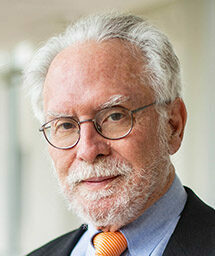
Professor David Patterson
David Patterson holds the Hillel A. Feinberg Distinguished Chair in Holocaust Studies at the Ackerman Center for Holocaust Studies, University of Texas at Dallas, and is a Senior Research Fellow for the Institute for the Study of Global Antisemitism and Policy (ISGAP). He has lectured at universities on six continents and throughout the United States. A winner of the National Jewish Book Award, the Koret Jewish Book Award, the Hadassah Myrtle Wreath Award, and the Holocaust Scholars’ Conference Eternal Flame Award, he has published more than 40 books and more than 250 articles, essays, and book chapters on antisemitism, the Holocaust, and Jewish studies.
On 15 June 2026 Karolina Kijek published an article in the Polish newspaper Gazeta Wyborcza titled “In the Third Reich he was supposed to ‘de-Judaise the law.’ Disciplinary proceedings for a critique of silence on Nazism.” In the article Kijeck reports that a doctoral student named Samuel Maruszewski made an announcement on Facebook for the book Order as a Primary Value in Carl Schmitt’s Theory of State and Law by Bartosz Chrząszcz, published in March 2026 by the University of Wrocław Press. Maruszewski pointed out that the announcement made no mention of the Schmitt notorious Nazi affiliations, and similarly critical voices chimed in. He expected the publisher to engage in an academic discussion of the matter. Instead, reports Kijek, the comments under the post were censored, and disciplinary proceedings were initiated against the doctoral student.
The university press announcement framed Schmitt (1888–1985) as an “intriguing and interesting jurist,” one who strived “towards the preservation of order and fending off chaos,” and whose work continues to invite fresh interpretation. It turns out that “fresh interpretation” in this instance amounts to yet another case of Holocaust revisionism and denial.
Apparently, the promotional material for the book overlooked a few salient points about the controversial jurist. In 1933, for example, Schmitt joined the Nazi Party and brought to bear his prowess as a legal and political theorist in the ideological service to the Reich. He served on the Prussian State Council and the Academy for German Law and was president of the National Socialist Association of Legal Professionals. It is worth noting that in 1935 the Association attempted to have the word Mensch or “human being” removed from the legal codes because it created confusion. What the announcement of the book on Schmitt failed to mention was that he was an antisemite, a member of the Nazi Party, and one of the Third Reich’s most prominent jurists. He supported Hitler’s regime and participated in the effort to “de-Judaize” German law.
Although he fell out of favor with the Nazi regime in 1936, Schmitt’s influence as a legal scholar remained, as his theories proved to be instrumental in the passage of the Law to Remedy the Distress of People and Reich, otherwise known as The Enabling Act of March 23, 1933. The “emergency” that led to the passage of the law was the burning down of the Reichstag on February 27, 1933. The new law granted the Führer the extraordinary authority to enact laws without approval from the Reichstag or the president. With the passage of the Enabling Act, Hitler and the Third Reich were irrevocably in place. It is hardly coincidental that the concentration camp at Dachau opened the day before the passage of the law that gave the Führer unlimited power.
Having written about emergency conditions that might arise in a liberal democratic state ten years earlier, Schmitt presciently outlined the basic features of The Enabling Act, arguing that, under extreme circumstances, the law may (1) grant special powers to the executive, (2) suspend the ordinary rule of law, and (3) abolish legal and constitutional rights. Thus his thinking helped to lay the groundwork for Hitler’s rise to power by providing the theoretical justification for the Nazis’ totalitarian rule. Central to this theory was the Führerprinzip (leader principle), which ascribed to the Führer absolute legal and political authority. The justification of the Führerprinzip, according to Schmitt, lay in the Völkisch or racial composition of the German people and their identification with Hitler.
Justifiably disturbed by this calculated omission in the promotion of the book about Schmitt—especially coming from a public university in a country so profoundly scarred by the Holocaust and World War II—Maruszewski posted two strongly worded comments on social media condemning the omission as a “shocking” and unacceptable “whitewashing of Nazism” on the part of the university press. As a responsible young scholar, he was careful to provide Schmitt’s documented historical background as outlined in the Encyclopedia Britannica.
Rather than addressing the ahistorical and unethical omission in the promotion of the book or engaging in scholarly dialogue, the University administration hid Maruszewski’s comments and initiated formal disciplinary proceedings against him. The Vice-Rector for Student Affairs and the Disciplinary Ombudsman are currently investigating him for allegedly “breaching the dignity of a doctoral candidate,” which can lead to his dismissal. This retaliatory escalation represents an anti-democratic, anti-free-speech measure aimed at silencing critical inquiry in a case where Holocaust memory is undermined; it creates a chilling effect across the academic community, both in Poland and abroad. A legal defense has been mounted by the grandson of one of the Righteous Among the Nations, Professor Tomasz T. Koncewicz, Visiting Scholar at Princeton, to come to Maruszewski’s aid.
The eclipse of what is higher in higher learning begins with the abrogation of the truth and the silencing of anyone who might call into question lies perpetrated by omission. The case before us has implications for all who value free inquiry and the search for the truth in academia and elsewhere. Those of us who still have a voice cannot be silent in the face of this travesty that has befallen Samuel Maruszewski. Are we going to stand idly by in the presence of such iniquity? How we answer will decide who we are, what we stand for, and what we shall refuse to stand for.
To submit an article to ISGAP Flashpoint, paste it into the email body (no attachments). Include a headline, byline (author/s name), and a short bio (max. 250 words) at the end. Attach a high-quality headshot. Send submissions to [email protected].