
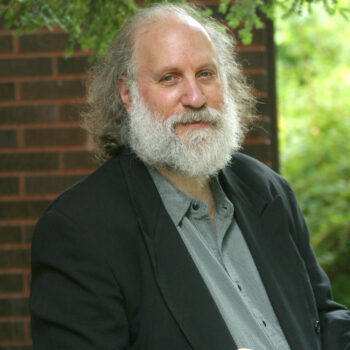
Cary Nelson
Dr. Cary Nelson is an ISGAP faculty member and an emeritus professor at the University of Illinois Urbana-Champaign. He is the author of two ISGAP books, Hate Speech and Academic Freedom; The Antisemitic Assault on Basic Principles (2024) and College Zionists Confront the Abyss: The Aftermath of October 7 in Higher Education and Its Consequences for Progressive Politics (forthcoming, 2026). A former president of the American Association of University Professors, he is affiliated with the University of Haifa and holds an honorary doctorate from Ben-Gurion University of the Negev.
Presented at the European Parliament, Brussels, September 3, 2025:
I must begin by congratulating B’nai B’rith International, Democ, and the European Union of Jewish Students on the September 2025 publication of their extremely important report, “‘A Climate of Fear and Exclusion’: Antisemitism at European Universities”. Covering nine countries (Austria, Belgium, France, Germany, Italy, The Netherlands, Spain, Sweden, and The United Kingdom), it is the first such comprehensive and comparative report to be published and fills a serious gap in international understanding. In US and Canada in particular there is a tendency to think of the worldwide antisemitic movement that swept cities and campuses in 2023 and 2024 as primarily North American, at best North American and British when in fact it was the first such worldwide movement the world has ever seen. The closest predecessors we can reference are the Christian church’s universal adoption of the belief that the Jews killed Jesus and the racialized antisemitism that the Nazis imposed on or drew out of the European countries they conquered.
I just completed a book about the worldwide movement since 10/7. Titled College Zionists Confront the Abyss, it will be jointly published by the Institute for the Study of Global Antisemitism and Policy (ISGAP) and Academic Studies Press next year. There is certainly a lot in the report that I did not know until Alina sent me an advance copy. I integrated numerous citations into the book manuscript. Thus I have personal reason to believe the B’nai Br’ith/Democ/EUJS report will be immensely useful and influential for scholars and concerned members of the public. It also gives government and NGO leaders a road map and context for planning responses and reforms going forward.
The most stunning and unsettling feature of the report is the inescapable similarities of rhetoric and tactics employed by the antizionist groups in all of the nine nations covered in individual essays.
To that pattern we can add that of the US, Canada, and other countries worldwide. The encampments started in the US and, within three weeks, had spread to Europe and much of the world. Australia had encampments at eleven universities. Kuwait had an encampment at Kuwait University, Jordan at University of Jordan, Lebanon at Beirut Arab University, South Africa at the University of Cape Town, Turkey at Istanbul Teknik University, Yemen at Thamar University, Costa Rica at the University of Costa Rica, Finland at the University of Helsinki, Greece at the National and Kapodistrian University of Athens. Mexico had encampments at the National Autonomous University and at University of Guadalajara. Poland had two as well, at Jagiellonian University in Kraków and at University of Wrocław. Brazil had two encampments, including one at the University of Sao Paulo. Japan had seven campus encampments: Hiroshima, International Christian, Kyoto, Sophia, Tama Art, Tokyo, and Waseda. The largest country without any was China, but only because the state prohibits public demonstrations. But Chinese social media was flooded with antizionist conspiracy theories and with the slogans chanted
throughout the rest of the world.
As the new report on Europe makes clear, none of this could have happened without the sharing of plans, strategies, tactics, rhetoric, and ideology on social media. Some clandestine planning took place in private chat groups.
The report does a concise, effective job of capturing differences and similarities among the countries covered. It is quite compelling, even unsettling, to see the widespread duplication of ideology and tactics across European campuses. Despite the basic uniformity of the protests, the responses of university administrators were divided between those who resisted student demands and those who applauded and at least roughly complied with them. National policies toward Israel split as well between those nations sympathetic to Israel and those hostile. From this distance at least it seems impossible to bring, say, Spain and Britain under one comprehensive set of EU recommendations about how to deal with campus demonstrations exhibiting antisemitic rhetoric, though perhaps tactics like building occupations could be addressed with consensus.
What can we learn from all of this—and what is new?
First, the encampments no longer agitated for a two-state solution. Nor did they promote the one-state fantasy in which Jews and Palestinians live together happily ever after. They demanded an end to the Jewish state.
Second, they no longer made an issue of the occupied territories. They insist all Palestine is illegally occupied.
Third, the crucial date, the founding crime, is thus not 1967 and the war that won Gaza and the West Bank for Israel but 1948 and the founding of Israel.
Fourth, in an antisemitic fantasy, Israel is conceived as the main force thwarting worldwide liberation and social justice.
Fifth, Jews worldwide, most of them Zionists, are considered part of an international conspiracy.
Sixth, the distinction between antizionism and antisemitism has been dissolved.
Seventh, as the widespread incidents demonstrate, the current discussion is rooted in hatred, not political conviction.
That makes serious reflection about recommendations for action more important that ever before. There are certainly steps to take to begin alleviating Jewish alienation on campus. The report offers nine good recommendations. I would add universal training in the history and current status of antisemitism. Number seven—ensure professors and course content meet academic standards and provide
students with balanced perspectives—is aspirational. The present reality falls far short. Courses proposals are reviewed and approved by campus committees, but once they get on the books it’s usually up to individual departments to maintain quality and balance. Many substantially anti-Zionist departments—from Middle East studies to Women’s Studies—are interested in nothing of the kind. They are dedicated to telling their students that Israel is a force for evil.
I’ve been fighting the boycott movement since 2006. I’m in my 20 th year. We’ve won many battles, but conditions for Jews on campus overall have gotten progressively worse. I am convinced that, unless we tackle the problem of antizionist indoctrination programs, we will gradually face more, not less antisemitism.
It is consequently imperative that we confront the single major source of campus antisemitism: radically antizionist academic disciplines and their local departments. Many of the most antisemitic faculty call those departments their academic home. Those departments sponsor many of the most relentlessly antizionist and antisemitic courses. They graduate the most thoroughly indoctrinated antizionist students. They dedicate themselves to producing hostile environments for their communities. Academic receivership is the only reliable way we have of addressing the problem. In receivership, the department head is replaced by someone outside the department, and an external committee takes charge of both recruitment and personnel decisions. The department would lose its independent power over both student and faculty recruitment. We can expect massive resistance to this recommendation, but I believe it is necessary. Without confronting the problem of hostile departments, every other tactic for addressing campus antisemitism will fail. That includes the recommendations in the report. But nothing is possible without public disclosure of what has taken place. Campuses, indeed, wlll need highly detailed reports covering local events. A few campuses have begun issuing detailed local reports, but many more will need to do so to establish the need for local action. This excellent report begins that essential process on behalf of Europe.
To submit an article to ISGAP Flashpoint, paste it into the email body (no attachments). Include a headline, byline (author/s name), and a short bio (max. 250 words) at the end. Attach a high-quality headshot. Send submissions to [email protected].